- Opinion | Budget Strategy: Fiscal Sustainability, Innovation Capacity, and Inclusive Growth
- OPINION
- 2026-02-27 11:28
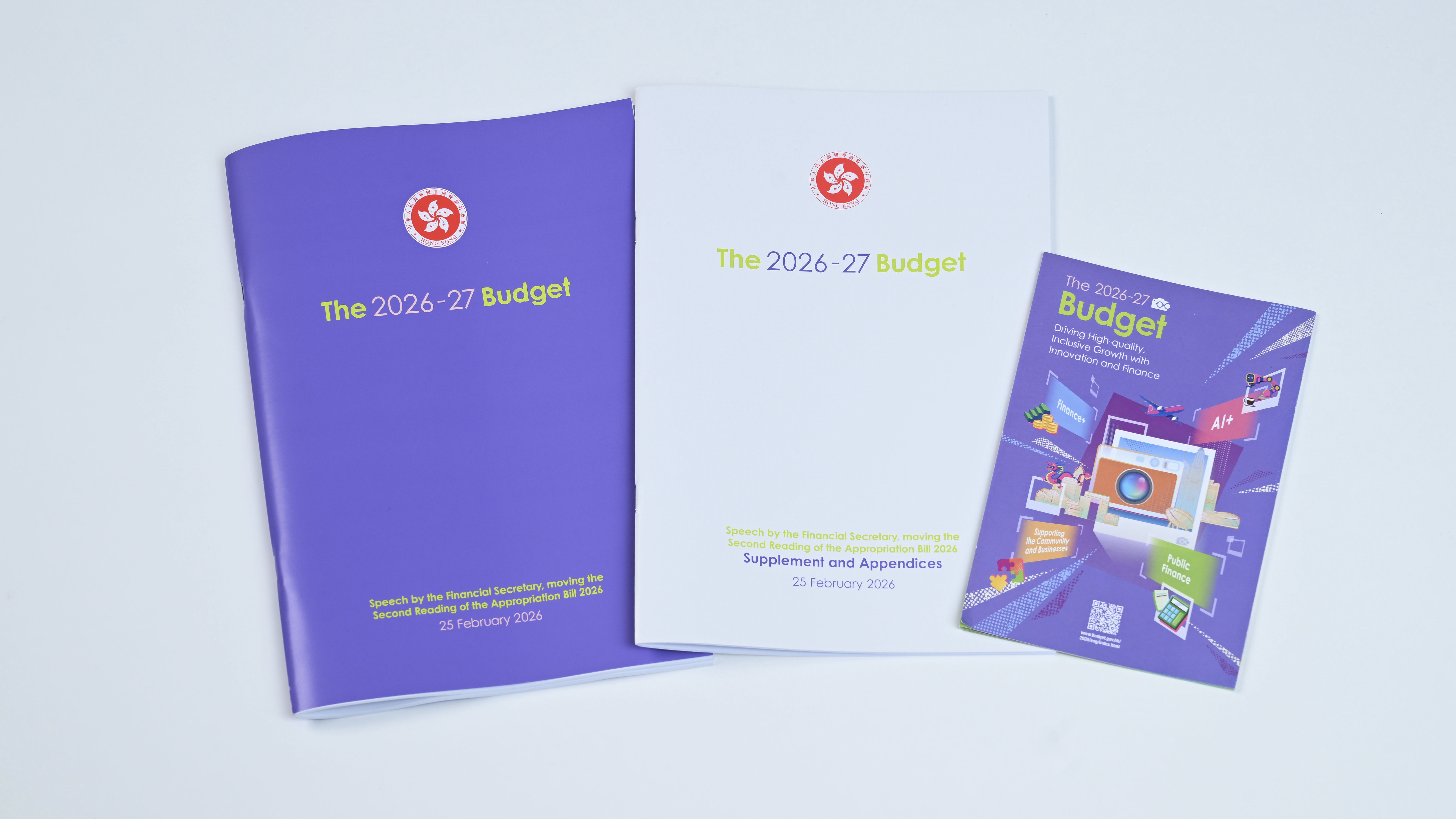
This year’s Budget of Hong Kong is commendable for its refusal to be distracted by short-term noise in a still-volatile external environment. Instead, it is organized around a clear governing logic: innovation-led growth, finance-enabled development; diversified expansion, and people-centred support; and translates the call to “maintain momentum and accelerate the economy” into a set of operational, measurable, and sustainable policy choices. The overarching message is straightforward: Hong Kong is re-aligning its development model by using prudent fiscal management as the foundation, innovation and industrial upgrading as the engine, Hong Kong - Shenzhen Innovation and Technology Park (Hetao) as the physical platform, and the city’s financial system as the amplifier, while protecting social confidence through more targeted livelihood measures. In a transition period, the aim is to remain stable enough to withstand shocks, yet agile enough to move faster.
At the macro level, the Government projects real growth of about 2.5% to 3.5% for the year, with underlying inflation around 1.7% and headline inflation around 1.8%, and it anchors the medium-term outlook on average annual growth of roughly 3% in the 2027–2030 period. The significance lies both in the forecast and in the Budget’s answer to how Hong Kong can preserve policy predictability amid uncertainty: it acknowledges ongoing external risks and an uneven interest-rate path, while attempting to reduce policy swing by strengthening fiscal institutions and narrowing investment priorities so markets and households can plan with greater confidence.
In addition, the Budget is encouraged by a faster-than-expected improvement in public finances and frames this improvement as a structural shift. A stronger economy and capital markets, higher tax receipts, and the effects of an enhanced fiscal consolidation plan have lifted revenues, with stamp duty and profits tax outperforming earlier estimates by a large margin. As a result, the operating account is projected to return to surplus, and the overall accounts, factoring in bond issuance, move back toward balance earlier than expected. This matters because it expands the Government’s feasible policy space: it can continue investing in long-horizon priorities while providing calibrated relief to residents and small businesses, rather than oscillating between heavy stimulus and abrupt retrenchment.
On fiscal strategy, the Budget signals “discipline with foresight.” It reiterates the principle of living within means, prioritizing control of recurrent expenditure growth while keeping the simple, low-tax regime, avoiding broad-based tax hikes or major new taxes that could weaken Hong Kong’s competitiveness. Expenditure restraint is pursued through efficiency programmes and planned civil service establishment reductions, while revenue measures are framed around “those with greater means contribute more,” including adjustments affecting high-value property transactions and the implementation of global minimum tax arrangements.
This direction aligns with themes highlighted in the attached study by Todorova (2019), which reviews theory and evidence on the relationship between fiscal balance and growth and argues, based on comparative and regression analysis for European countries, that larger deficits do not reliably deliver stronger growth, and that improving fiscal balance (moving toward surplus / reducing deficit) is often associated with better growth outcomes. In the paper’s results, the estimated relationship is generally positive between budget balance (as a share of GDP) and real growth across the sample, while emphasizing that findings are conditional and country-specific. While Hong Kong’s structure differs from the European cases examined, the Budget’s emphasis on disciplined recurrent spending, non-distortionary taxation, and credibility in medium-term balance reflects the paper’s broader caution: deficit-financed spending, especially if inefficient, can fail to generate durable growth and can burden future policy flexibility.
At the same time, the Budget clarifies the composition of the deficit challenge: the pressure is concentrated on the capital/infrastructure side (non-operating account), tied to high levels of investment in long-term development. Rather than forcing development spending into recurrent financing, the Budget expands bond-program headroom and lays out multi-year issuance plans, explicitly stating that proceeds will be used for infrastructure rather than day-to-day spending. It also deploys fund transfers and other financing arrangements to provide steadier support for flagship projects. Conceptually, this is an attempt to separate (i) recurrent fiscal sustainability from (ii) long-gestation capital formation, while maintaining transparency and protecting monetary and financial stability.
Where the Budget most clearly signals “acceleration” is its “AI+” agenda, which is presented not as a slogan but as a pipeline, strategy coordination, R&D, funding, computing capacity, talent, data governance, and public-service applications, aimed at driving “AI industrialization” and “industry AI adoption.” A high-level strategy body is created to focus initially on life and health technology and embodied intelligence, complemented by expanded research platforms, a dedicated AI funding programme, and a new research institute intended to push commercialization and advise on governance and regulation. Talent measures extend from universities to workforce upskilling, while government-wide adoption targets concrete use cases (e.g., transport management, job matching, and disaster prevention).
Yet the decisive test for Hong Kong’s IT development is not only how much is invested, but how quickly ideas are translated into deployable solutions. Hong Kong has long been strong in application-oriented research, and the Budget rightly emphasizes technology development and adoption. However, a practical gap remains in the innovation pipeline: bridging university research to real-world implementation at scale, through problem definition with users, rapid prototyping, validation in live settings, and sustained iteration after deployment. This is precisely where researchers in local universities can add high-impact value. Work being advanced at Lingnan University under President Joe Qin and his team points to a constructive direction: closer alignment between academic research agendas and societal/industry needs, stronger interdisciplinary collaboration (e.g., linking data science, social policy, business, and governance), and clearer pathways for turning research outcomes into usable applications, especially in public-service digitalization and “AI+” scenarios. Hong Kong is expected to convert the Budget commitments into visible productivity gains, better services, and scalable innovations, rather than leaving promising IT initiatives stranded between laboratory results and operational reality.
Industrialization, however, requires space and institutional throughput. The Budget positions the Northern Metropolis as a future growth pole consistent with “south finance, north innovation,” accelerates land and project development via a “large-site/area” approach, and advances a dedicated company model for key zones. For Hetao, it injects resources to speed infrastructure and supporting facilities, strengthens startup support (including venture capital), and seeks greater cross-boundary flow of research-related factors, such as data and biomedical samples, through streamlined mechanisms. The aim is to shorten the distance from research to prototyping, scale-up, production, and market expansion, leveraging complementarities with the Greater Bay Area.
On financial services, the Budget deepens traditional strengths while building new infrastructure. It supports offshore RMB liquidity and issuance across tenors to strengthen the yield curve and attract quality issuers, pushes market reforms (including settlement and paperless securities), expands electronic bond trading, and treats tokenized bond issuance as a more regular financing tool. It also enhances the competitiveness of fund and family-office regimes by broadening qualifying assets. Together with a clearer digital-asset regulatory pathway, these measures position finance as a lever to fund innovation and industrial upgrading.
On livelihoods, the Budget aims to be both compassionate and restrained, combining one-off relief (rates concessions, tax reductions, targeted extra support for eligible recipients) with more structural tax-base adjustments that reduce household burdens over time (e.g., increases in key allowances and deductions). Elderly care receives measurable capacity expansion through additional community and residential care vouchers, along with steps to facilitate cross-boundary retirement support, and healthcare policy continues shifting toward primary care networks and preventive management. Youth measures emphasize exposure, internships, and skills aligned with a more AI-enabled economy, while housing policy continues to expand public supply and transitional solutions.
Taken as a whole, the Budget reflects a “re-investment” logic: strengthen fiscal credibility and recurrent discipline to keep the system sustainable; concentrate development spending on innovation, enabling infrastructure, and new economic space; and translate new growth drivers into jobs, incomes, and upward mobility through education, skills, and digitalized public services. In light of the attached research (Todorova, 2019), which cautions that higher deficits and “pumping up” public spending do not guarantee stronger growth, the Budget’s attempt to pair development ambition with fiscal consolidation can be read as an effort to avoid the trap of growth-through-deficits and instead pursue growth-through-productivity, investment quality, and institutional efficiency. The real test will be execution: whether approvals become faster, whether real-world application scenarios are easier to deploy, whether research–capital–industry linkages tighten, and whether young people can enter new value chains and see clearer mobility pathways. If these connections are strengthened, the Budget’s message is not merely a return to balance, but a strategy to convert disciplined public finance into broad-based, long-run prosperity.
Reference:
Todorova, T. P. (2019). Government budget balance and economic growth. Journal of International Scientific Publications, 13(9), 1689-1699.
By Dr. Philip Wong
Deputy Director of STEAM Education and Research Centre, Lingnan University
Mr. Xiongyi Guo
Assistant Research Officer of Pan Sutong Shanghai-Hong Kong Economic Policy Research Institute, Lingnan University
The views do not necessarily reflect those of Orange News.
Cover Photo: Information Services Department
責編 | 李永康
編輯 | Gloria
編輯推薦
-
![]()
The Cost of Speed: Change, Complexity and Resilience in Property Development
OPINION | 2026-05-21 10:28 -
![]()
Opinion | A Short Visit, A Long Agenda: Analysing Donald Trump’s May 2026 Trip to China Through Game Theory and QCA
OPINION | 2026-05-15 17:38 -
![]()
Opinion | Hong Kong’s Licence Caps: Decide the Number, Then Regulate
OPINION | 2026-05-14 12:13 -
![]()
Opinion | Growth Is Good, Now Deliver the Upgrade
OPINION | 2026-05-11 14:18 -
![]()
Opinion | Property Is More Than a Number
OPINION | 2026-05-07 15:05 -
![]()
Opinion | The Road Map Hong Kong Should Follow in the GBA Chapter
OPINION | 2026-05-06 10:42







每周財經熱點|法拉利純電動車登場嚇跌股價、三星派天價花紅避過罷工危機

俄羅斯無人機擊中羅馬尼亞民居致2人受傷 歐盟斥嚴重侵犯主權及領空

專題|青年畢業即失業 職位空缺三年跌足六成 重災區唔止IT界

搵錢呢啲嘢丨AI自動化吸引新血 最年輕僅廿多歲 本地鋼鐵商:若不變就會死